

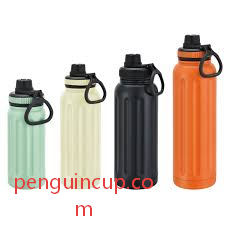
A gym session ends, and that large container of ice water now tastes lukewarm and unrefreshing. A long car ride turns a full gallon of chilled liquid into a room‑temperature disappointment. These experiences convince many people that Large Capacity Water Bottles cannot keep water cold as effectively as their smaller counterparts. Penguincup, manufactured by YuNeng, challenges this assumption through industrial‑grade vacuum insulation and precision welding. Yet the question persists in the minds of anyone who carries a big bottle: does a large capacity water bottle keep water cold as effectively as a smaller insulated bottle?
The answer depends entirely on construction quality, not on volume. A small insulated bottle maintains cold temperatures because its double walls create a vacuum zone that blocks heat transfer. A large bottle uses the same physics. The only difference involves the ratio of surface area to volume. A bigger container exposes more surface area to outside warmth, yet it also holds more thermal mass. Proper engineering compensates for the surface area difference. YuNeng achieves this through tailless vacuum technology, removing every trace of conductive gas from between the stainless steel layers.
Welding integrity determines whether a large bottle performs like a small one. Any microscopic gap in the neck weld allows air to seep back into the vacuum space. That tiny leak destroys insulation capacity within weeks. Cheap large bottles use basic welding that fails under temperature changes. YuNeng applies laser welding equipment across its 30,000‑square‑meter factory, creating seals that withstand years of hot and cold cycling. A Penguincup large bottle leaves the factory with the same vacuum integrity as a Penguincup small bottle.
Wall thickness plays a hidden role in cold retention. Thin stainless steel transfers heat faster than thick steel, regardless of bottle size. Many large capacity bottles use thinner walls to reduce weight and material costs. That weight saving comes at the expense of performance. YuNeng draws its own tubes from raw stainless steel, controlling thickness to maintain insulation properties. A Penguincup large bottle feels solid because its walls provide genuine thermal resistance, not just a cosmetic shell.
Lid design affects heat gain through the top opening. A small bottle lid covers a narrow mouth, naturally limiting heat entry. A large bottle requires a wider opening for filling and cleaning. That wider opening invites heat intrusion unless the lid incorporates proper sealing. YuNeng engineers Penguincup lids with multiple gaskets and a defined locking position. The lid does not simply rest on threads; it seals against a precision‑machined surface. That design blocks heat entry regardless of bottle diameter.
Testing separates genuine performance from marketing claims. A manufacturer can print any ice retention number on a box without proof. YuNeng operates salt spray and optical spectroscopy equipment on site, verifying each production batch. Every Penguincup undergoes real temperature measurements before shipping. A customer receives a large bottle that has already proven its cold retention in a testing facility, not just on a specification sheet.
The shape of the vacuum layer matters as much as its presence. Cheap large bottles create an uneven gap between inner and outer walls. That unevenness creates convection currents inside the vacuum space, moving heat around the bottle. YuNeng's tailless vacuum process creates a consistent gap from top to bottom. No convection currents form because the vacuum remains uniform. A Penguincup large bottle stops heat transfer through every square inch of its surface, not just in certain zones.
Material quality affects long‑term performance. Low‑grade stainless steel contains impurities that corrode over time. That corrosion can breach the vacuum seal from the inside. YuNeng sources food‑grade stainless steel and tests each batch with optical spectroscopy. The Penguincup large bottle resists corrosion that would eventually destroy a cheaper bottle's insulation. A customer buying for the long term receives a product designed to retain cold for years, not months.
For anyone seeking a large bottle that actually keeps water cold, https://www.penguincup.com/ offers the Penguincup line built with industrial vacuum technology, laser welding, and rigorous testing. A full day in a hot car or a long shift at a construction site should not end with warm water. Why accept poor performance from a big bottle when proper engineering solves the problem completely?