



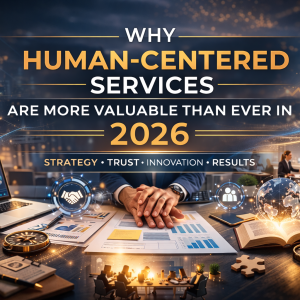

For decades, services followed a familiar pattern: in-person delivery, fixed locations, manual processes, and human interaction at every step. From consulting and accounting to maintenance, education, and customer support, services were built around physical presence.
That model is now being fundamentally reshaped.
Digital transformation isn’t just improving how services are delivered — it’s redefining what a service is, how it’s accessed, and what people expect from it. And despite common fears, this evolution isn’t about replacing humans. It’s about changing how expertise is delivered.
The Forces Driving Service Transformation
Three major forces are accelerating change across nearly every service industry:
1. Automation & AI
Routine, repeatable tasks are increasingly handled by automation and artificial intelligence. Scheduling, diagnostics, first-level support, reporting, and analysis can now happen instantly — often without human intervention.
As highlighted by research from MIT Technology Review, AI is most effective not where judgment is required, but where speed, consistency, and scale matter.
2. Remote & Digital Delivery
Geography is no longer a barrier. Services once tied to physical offices — consulting, training, design, legal reviews — are now delivered digitally, often across borders and time zones.
3. Hybrid Expectations
Most services no longer fit neatly into “traditional” or “digital” categories. Clients expect hybrid models that combine automation with human expertise — fast where possible, personal where necessary.
Which Services Are Transforming the Fastest?
Some sectors are evolving faster than others, largely based on how digitizable their processes are.
Rapidly Transforming Services
- Customer support & help desks
- Marketing & analytics services
- Financial reporting & compliance preparation
- Education & professional training
- IT, development, and technical consulting
According to insights from Deloitte, these services benefit most from automation because large portions of their workflows are structured and repeatable.
Slower — but Still Changing
- Healthcare and wellness services
- Skilled trades and maintenance
- Personal advisory services
Even here, digital tools now support diagnostics, scheduling, documentation, and communication — reshaping how value is delivered.
Why Digital Doesn’t Replace Human Expertise
One of the biggest misconceptions around digital transformation is that technology removes people from services.
In reality, it does the opposite.
Digital tools:
- Remove low-value, repetitive tasks
- Free professionals to focus on judgment and creativity
- Improve consistency and reduce errors
- Enhance transparency and responsiveness
As Accenture frequently notes, the most successful transformations occur when technology amplifies human capability, rather than attempting to replace it.
Expertise still matters. What’s changing is how that expertise reaches the client.
The Rise of Hybrid Service Models
The most effective modern services operate in layers:
- Digital front-end
Fast access, self-service options, automation, and instant feedback.
- Human expertise layer
Advisors, specialists, and professionals step in when complexity or judgment is required.
- Continuous support
Ongoing digital monitoring, updates, and optimization — not one-off delivery.
This hybrid approach allows services to be:
- Faster
- More scalable
- More affordable
- More consistent
And crucially, more aligned with modern expectations.
New Service Expectations in 2026
By 2026, service users increasingly expect:
- Immediate access and visibility
- Clear explanations of what’s automated vs human-led
- Flexible engagement models (project, subscription, hybrid)
- Digital transparency without losing personal connection
Services that fail to adapt aren’t seen as “traditional” — they’re seen as inefficient.
Where Servicingpedia Fits In
With services evolving so quickly, confusion is inevitable. Buzzwords, hype, and fear often replace understanding.
This is where Servicingpedia plays a vital role.
Servicingpedia exists to educate, explain, and clarify how services actually work — without sales pressure or technological exaggeration.
The platform focuses on:
- Clear breakdowns of traditional vs digital service models
- Explaining how automation and AI fit into real services
- Helping businesses, professionals, and clients understand what’s changing — and why
- Providing neutral, structured insights across industries
Instead of telling readers what to fear or buy, Servicingpedia helps them understand.
Understanding Change Without Fear
Digital transformation isn’t the end of traditional services. It’s their evolution.
The services that thrive are those that:
- Embrace technology where it adds value
- Preserve human expertise where it matters
- Communicate clearly with clients
- Adapt to how people actually work and live today
Knowledge is the difference between disruption and progress.
Final Thought
Services aren’t disappearing — they’re becoming smarter, more flexible, and more human where it counts.
Servicingpedia helps people understand how services evolve — without hype, fear, or confusion.
And in a world where everything is changing at once, clarity is the most valuable service of all.