

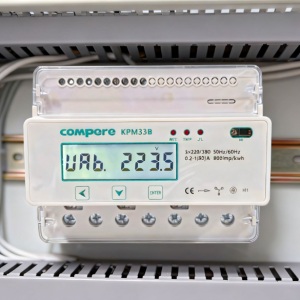
In today's data-driven era, enterprise managers strive for transparency and optimization in every aspect of the supply chain, production processes, and sales channels. However, one crucial cost item has long remained a "black box"—electricity consumption. Monthly electricity bills are merely delayed, aggregated figures, failing to answer questions such as: "Where is the electricity being used?", "Is there waste?", and "Is the equipment operating healthily?"
The traditional "monthly meter reading" model can no longer meet the needs of refined management and sustainable development. The emergence of modern power monitoring systems is fundamentally changing this situation, transforming electricity from an uncontrollable expenditure into a strategic data stream that can be analyzed, optimized, and predicted.
I. More Than Just "Monitoring": The Core Value Leap of Power Monitoring Systems
Modern power monitoring is far more than simply reading numbers. It is a complete ecosystem integrating smart hardware (such as IoT meters and sensors), network communication, and cloud platform software. Its core value represents a triple leap:
From "Result Recording" to "Process Insight": The system collects dozens of parameters in real time, including voltage, current, power, power factor, and power quality, at a frequency of seconds or minutes. Managers can view the "electricity consumption electrocardiogram" of the entire plant, each workshop, and even critical equipment, just like viewing real-time production line data, completely eliminating guesswork.
From "Cost Center" to "Efficiency Center": Through data, enterprises can accurately identify "energy consumption loopholes"—such as standby energy consumption during non-production periods, inefficient old equipment, and unreasonable equipment start-up and shutdown sequences. One manufacturing company reduced its annual electricity costs by 15% by analyzing monitoring data and optimizing only its air compressor operation strategy.
From "Passive Response" to "Proactive Early Warning": The system allows setting thresholds for various parameters. When three-phase imbalance, abnormal harmonics, sudden increases in energy consumption, or abnormal equipment overheating (via associated temperature sensors) occur, the system automatically sends alerts via APP, SMS, etc., eliminating faults in their early stages, achieving predictive maintenance, and avoiding huge losses caused by unplanned downtime.
II. The Cornerstone of Digital Transformation: How Data Creates Concrete Business Value
Massive amounts of electricity consumption data are meaningless in themselves; only through analysis and application can they be transformed into tangible economic benefits.
Precise Energy Cost Allocation: For enterprises in multi-tenant industrial parks or with complex production lines, the system can meter electricity consumption by region, production line, work group, and even individual equipment, providing indisputable data support for internal cost accounting, energy conservation assessments, and lean production.
Optimized Energy Procurement Strategies: Through in-depth analysis of historical electricity consumption curves, enterprises can more accurately predict future loads, thereby choosing the optimal billing method (such as peak-valley flat pricing) when trading in the electricity market or signing contracts with power companies, significantly reducing basic electricity costs and electricity consumption fees.
Ensuring Production Safety and Quality: Power quality issues such as voltage drops and harmonic pollution are hidden killers that damage precision equipment and lead to product defects. The monitoring system continuously monitors power quality, providing "health records" for critical equipment and ensuring a stable and reliable production environment.
Empowering Sustainable Development and ESG Reporting: The system automatically generates carbon emission reports, clearly showcasing energy conservation and emission reduction achievements. This verifiable data serves as the best evidence to respond to environmental requirements from customers, investors, and regulators, enhancing a company's brand image and compliance.
III. The Future is Here: Deep Integration with IoT and AI
Power monitoring systems are evolving from "visualization" to "intelligence," becoming one of the central nervous systems of the Industrial Internet of Things (IIoT).
Integration with Building Automation Systems: Automatically adjusting the operating strategies of lighting, air conditioning, and ventilation systems based on real-time electricity prices and production plans.
Integration with Manufacturing Execution Systems (MES): Using unit product energy consumption as a key performance indicator, achieving refined management from "how much was produced" to "how much was produced with the highest energy efficiency."
AI-Driven Intelligent Diagnosis and Optimization: Artificial intelligence algorithms can learn normal energy consumption patterns of equipment, providing earlier warnings of potential faults. Simultaneously, AI can simulate and recommend globally optimal energy-efficient equipment scheduling schemes, achieving automated energy saving.
Conclusion
Deploying an advanced power monitoring system is no longer a simple "icing on the cake," but an essential path for enterprises towards intelligent manufacturing, sustainable operation, and resilient development. It brings more than just a direct reduction in electricity costs; it leads to a comprehensive improvement in operational transparency, production safety, refined management, and scientific decision-making.
Investing in power monitoring is investing in a company's "energy intelligence." When the flow and value of every kilowatt-hour of electricity are clearly visible, controllable, and optimized, companies truly grasp the invisible engine for cost reduction, efficiency improvement, and green development in fierce competition.